


Just three days ago, results were announced from the ADDRESS-LC Phase 2 trial that the Long COVID research community has been waiting on. A patient advocate on the trial’s advisory board described them as the clearest and most compelling results seen from any Long COVID trial to date. The full picture is more nuanced than that framing suggests and the nuance matters. But the signal is real, the findings are biologically coherent and a Phase 3 trial is now being planned. This piece decodes what it means… and what the appropriate level of cautious optimism looks like.
What bezisterim is
Bezisterim, also known as NE3107, is an oral anti-inflammatory compound developed by BioVie. It targets neuroinflammation through the NFκB signalling pathway, one of the primary drivers of inflammatory amplification in the central nervous system. The mechanistic hypothesis behind its use in Long COVID is that persistent spike protein fragments from SARS-CoV-2 drive chronic NFκB activation, producing the neuroinflammatory environment that underlies fatigue, brain fog, cognitive impairment and post-exertional malaise.
Bezisterim is taken as a 20mg oral capsule twice daily. It has previously been studied in Parkinson’s disease and Alzheimer’s disease, where it showed signals of benefit in cognitive and motor domains alongside biomarker improvements. Those earlier signals informed the decision to test it in Long COVID, where neuroinflammation is increasingly recognised as a central feature.
It is worth noting how bezisterim differs from other drugs being discussed in this space. LDN and metformin have both been proposed as having anti-inflammatory effects relevant to Long COVID. But they work through different mechanisms and the clinical evidence base for both in Long COVID remains weak. A 2026 systematic review and meta-analysis of LDN in Long COVID identified only four observational pre-post studies with 155 participants combined and no randomised controlled trials. Bezisterim, by contrast, has now completed a randomised, double-blind, placebo-controlled Phase 2 trial specifically in Long COVID. That is a different category of evidence.
What the trial actually did
The ADDRESS-LC study was a Phase 2, randomised (1:1), placebo-controlled, multicentre trial enrolling 203 adults with Long COVID who had cognitive impairment and fatigue as primary features. Participants received bezisterim 20mg twice daily or matching placebo. The trial evaluated 22 clinical outcome measures covering overall clinical benefit, subjective and objective cognitive function, fatigue, sleep disturbance, quality of life and post-exertional malaise. The DePaul Symptom Questionnaire PEM domain was included as an endpoint, which is notable: PEM has historically been poorly captured in trial designs and its inclusion here reflects a more sophisticated understanding of Long COVID phenotyping.
The trial was designed primarily for treatment-effect estimation and hypothesis generation rather than as a conventional pivotal study testing a single pre-specified primary endpoint. This is an important design distinction. It means the trial was sized and structured to identify where bezisterim might be working and in which patient subgroups, rather than to provide definitive proof of efficacy. That is the appropriate design for a Phase 2 trial in a heterogeneous condition where the right patient population is not yet fully characterised.
The results: what the data actually shows
In the overall intention-to-treat population of 203 patients, none of the 22 endpoints reached statistical significance. This is the result that needs to be stated clearly because it is the one that matters most for the headline interpretation of the trial. Bezisterim did not demonstrate statistically significant benefit in the overall Long COVID population at this sample size.
However, 21 of the 22 endpoints showed numerical trends favouring bezisterim over placebo. That level of directional consistency across 21 out of 22 measures is not something that happens by chance in a randomised controlled trial with a matched placebo arm. It is a signal. The question is whether it is a signal that will hold up in a larger, properly powered study.
The pre-specified subgroup analyses are where the more striking findings emerge. Before the trial was unblinded, the investigators defined subgroups of patients with high baseline burden of fatigue, high PEM, or substantial objective cognitive impairment. Approximately 78% of participants belonged to at least one of these subgroups. In these groups:
Among the half of participants with the greatest fatigue burden, statistically significant differences appeared across five endpoints, three of which were specifically fatigue-related. There were also trends in PEM and sleep.
Among participants with high PEM, statistically significant improvements appeared across measures of malaise, fatigue and objective cognition.
Among participants who entered the trial with substantial objective cognitive impairment, statistically significant improvements appeared across four objective cognitive endpoints.
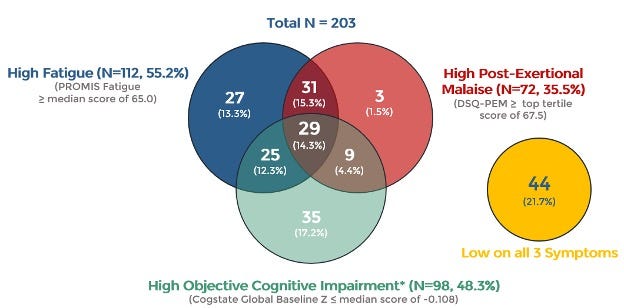
When the investigators compared effect sizes between the overall population and the high-symptom subgroups, the treatment effect sizes more than doubled in the subgroups. This pattern of a weak or absent signal in the overall population that becomes strong in a more targeted subgroup is exactly what you would expect if bezisterim works specifically in patients with a neuroinflammatory-driven phenotype rather than in all Long COVID presentations regardless of underlying mechanism.
Why this matters for understanding Long COVID
The subgroup pattern in the ADDRESS-LC results is not just a statistical curiosity. It has mechanistic implications. If bezisterim, which targets neuroinflammation via NFκB, works specifically in patients with high fatigue, high PEM and objective cognitive impairment, that is evidence that neuroinflammation is driving those specific features in those specific patients. It does not mean neuroinflammation drives all Long COVID. It means there is a subgroup, likely a large one given that approximately 80% of trial participants had high symptom burden on at least one measure, for whom neuroinflammatory mechanisms are the primary driver of their worst symptoms.
This is consistent with the increasingly accepted view that Long COVID is not one condition but a cluster of overlapping phenotypes with different dominant mechanisms. The patients for whom bezisterim showed the strongest signal, those with the highest fatigue, PEM and objective cognitive dysfunction, may be the patients whose Long COVID is primarily neuroinflammatory in character. A different subgroup, those with predominantly autonomic features or microclotting or viral persistence, may require different targeted interventions.
The honest caveats
These are Phase 2 results announced by the drug’s developer. They have not been published in a peer-reviewed journal and have not been independently analysed. Subgroup findings, even pre-specified ones, are exploratory and hypothesis-generating. They require confirmation in a prospective, adequately powered Phase 3 study. Effect sizes that double in subgroups can sometimes be an artefact of reduced sample size and inflated variance rather than a true treatment signal. BioVie is explicit about this in its announcement, describing the subgroup findings as exploratory.
The overall ITT analysis failing to reach significance is the most conservative and most reliable interpretation of the data. The subgroup results are promising and provide a rational basis for a Phase 3 trial, but they are not proof of efficacy in the clinical sense.
BioVie is a small pharmaceutical company. Phase 3 trials in Long COVID require substantial funding, large patient cohorts, regulatory engagement and the kind of infrastructure that takes years to establish. The announcement of intent to pursue Phase 3 is encouraging but the path from here to an approved treatment is not short.
What this means practically
Bezisterim is not available to patients. It is not approved for any condition and is currently only accessible through clinical trials. Patients who want to be considered for a potential Phase 3 trial should monitor clinicaltrials.gov under the study identifier NCT06847191 and the BioVie website for announcements.
For the broader community this result matters for two reasons. First, it is the strongest signal from any randomised controlled trial specifically targeting fatigue, PEM and cognitive dysfunction in Long COVID to date. The patient advocate comment that this is unlike anything seen from any other Long COVID trial reflects a real shift in the data landscape. Second, the subgroup pattern provides mechanistic evidence that neuroinflammation is a primary driver of the most disabling Long COVID features in a large proportion of patients. That finding has implications for how Long COVID should be phenotyped, which patients should be enrolled in future trials and which other anti-neuroinflammatory approaches are worth pursuing.
The evidence base for Long COVID treatment has moved today. Not as far as the most optimistic framing suggests, because the overall trial did not reach significance. Further than the most cautious framing would allow, because the pattern in 21 of 22 endpoints and the subgroup results are too consistent to dismiss.
The views and opinions expressed in Dysautonomia Decoded are my own and do not represent those of my employer or any affiliated organisation.
References
BioVie Inc. BioVie announces topline results from Phase 2 ADDRESS-LC trial evaluating bezisterim for the treatment of neurological symptoms associated with Long COVID. Globe Newswire. 15 September 2026. https://www.globenewswire.com/news-release/2026/09/15/3361943/0/en/biovie-announces-topline-results-from-phase-2-address-lc-trial-evaluating-bezisterim-for-the-treatment-of-neurological-symptoms-associated-with-long-covid.html
Manruipa. Bezisterim in Long COVID: a new approach to fatigue, brain fog and PEM. September 2026.
The Sick Times. Bezisterim may help with some Long COVID symptoms, drug’s developer reports in early trial results. 15 September 2026. https://thesicktimes.org/2026/09/15/bezisterim-may-help-with-some-long-covid-symptoms-drugs-developer-reports-in-early-trial-results/
ADDRESS-LC trial. ClinicalTrials.gov. NCT06847191.
This is such good news but I want it to be further along already
I have ME/CFS. Apparently, LC has recently been confirmed as the same disease. I take LDN which I do think has helped but I am still mostly bedridden. I appreciate your writing on this topic. I hope this new drug may improve my life—assuming it makes it to market.