


Last week, in the aftermath of the Telegraph’s sickfluencer piece, we decoded the historical, feminist and scientific context of why women’s illness is consistently dismissed. The piece resonated more than almost anything published on this newsletter. The comments, messages and shares made clear that this is not an abstract argument for most people reading this. It is a lived experience.
This week, a study published in BMC Pulmonary Medicine on 19 September 2026 provides another piece of that picture, this time in the form of 10 months of longitudinal data from a specialist post-COVID clinic at Hannover Medical School in Germany. It did not set out to make a political argument. It set out to measure what was actually happening to women and men with Long COVID over time, with careful statistical adjustment for every variable that might explain the difference away. Here is what it found.
What the study did
Researchers at Hannover Medical School, one of Germany’s leading academic medical centres, followed a dynamically enrolled cohort of patients attending their specialist post-COVID outpatient clinic over a 10-month observation period. All participants had confirmed SARS-CoV-2 infection with ongoing symptoms. Assessment included patient-reported outcome measures covering symptom burden, psychological distress and work productivity impairment, alongside pulmonary function tests, six-minute walk tests and capillary blood gas analysis.
Critically, all comparisons between sexes were adjusted for age, BMI, COVID-19 severity and comorbidities using generalised linear mixed-effects models. This adjustment matters because it rules out the possibility that the sex differences are simply explained by women being older, heavier, sicker during acute illness, or having more underlying conditions. After accounting for all of those factors, the sex differences remained.
What they found
Women experienced significantly higher symptom burden than men across the 10-month follow-up period. Women experienced significantly greater psychological distress. Women experienced significantly greater work productivity impairment. These differences were not present at a single timepoint and then disappeared. They persisted across the entire 10-month observation window.
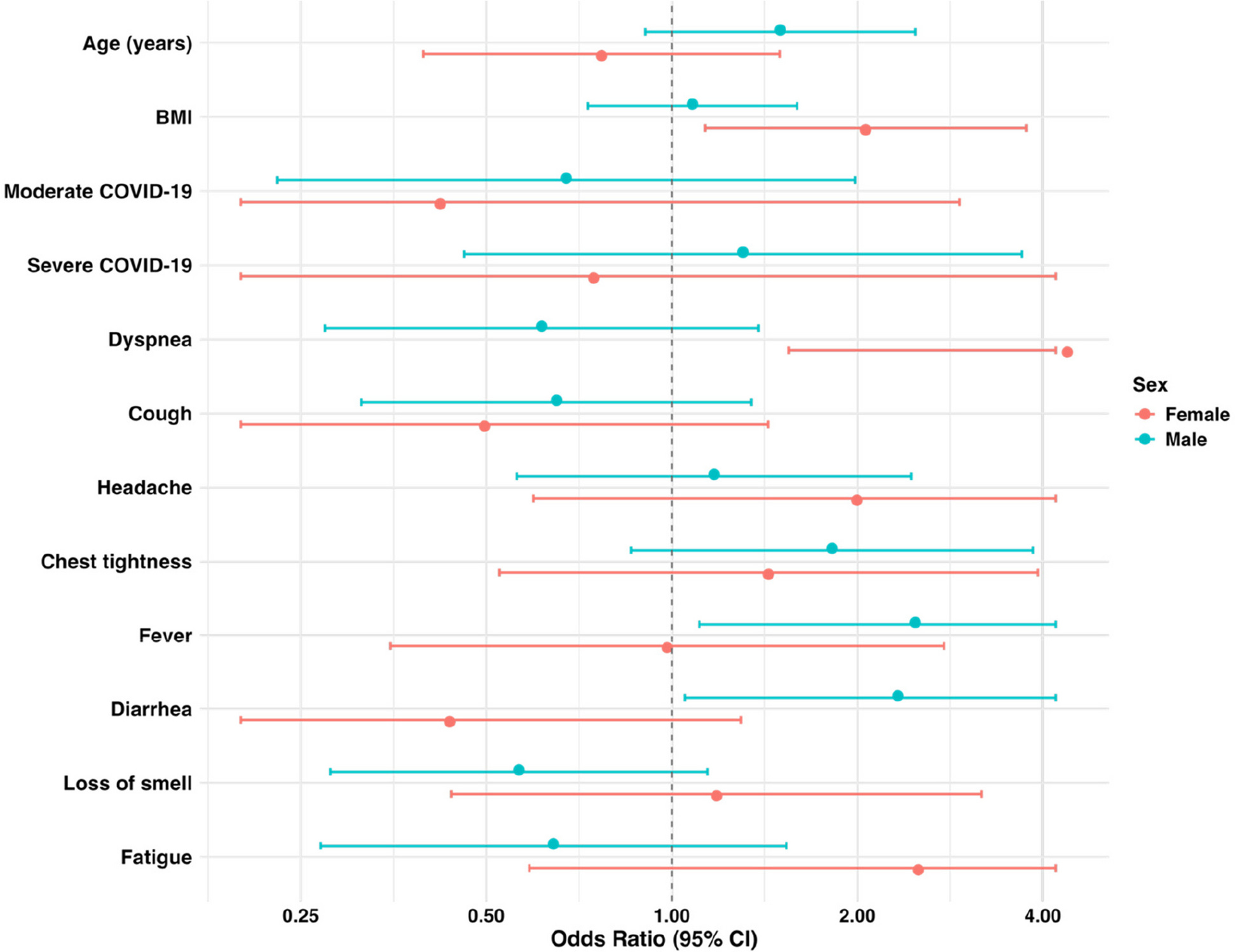
A complementary study published in Biology of Sex Differences in January 2026, which followed 34 Long COVID patients from 9 months to 5 years post-infection, found that females with Long COVID exhibited higher symptom burden, particularly persistent fatigue, neurocognitive and neurosensory complaints, which increased with age and tended to increase with disease duration. Males showed no clear age-related or duration-related patterns. Over half of participants in that study reported functional impairments affecting work capacity, with the burden falling disproportionately on female participants.
Why this is not surprising and why it matters that we keep saying so
The sex disparity in Long COVID symptom burden is consistent across the literature. It is not a finding unique to this study. What this study adds is longitudinal evidence over 10 months from a specialist clinical setting, with robust statistical adjustment, showing that the gap does not narrow over time.
The mechanisms are increasingly understood. Women have more robust immune responses than men in general, which produces better short-term defence but also makes immune dysregulation more likely. Oestrogen modulates mast cell activation, a key mechanism in the MCAS overlap with Long COVID. The premenstrual drop in oestrogen and progesterone reduces blood volume and worsens autonomic symptoms, which means women with Long COVID are dealing with a physiological challenge that compounds with hormonal fluctuation in ways men do not experience. Autonomic dysfunction, which affects a substantial proportion of Long COVID patients, is more common and more severe in women. The immune profile differences between male and female Long COVID patients, including reduced CD8+ T cell cytotoxic function and different inflammatory marker patterns in women, suggest the biological mechanisms driving symptoms differ by sex in ways that are not yet reflected in treatment approaches.
Work productivity impairment is the finding in this paper that deserves specific attention, because it connects directly to the economic inactivity argument made in the Telegraph piece we decoded last week. Women with Long COVID are not absent from work because disability has become a social identity. They are absent from work because they are measurably, objectively more impaired over a 10-month period, even after you account for every confounding factor the researchers could measure.
What the limitations of this study are
The study was conducted at a single specialist clinic in Germany, which means the patient population attending that clinic may not be representative of all Long COVID presentations globally. Patients attending a specialist post-COVID clinic are likely to have more severe or persistent symptoms than the general Long COVID population, potentially inflating apparent sex differences compared to what would be found in a community sample. The study also did not examine the biological mechanisms driving the sex differences, only the clinical outcomes. Understanding why the differences exist requires the kind of immune profiling and hormonal analysis that was beyond the scope of this observational study.
The bigger picture
A 10-month prospective cohort study from a specialist clinic, a 9-month to 5-year follow-up study of immune and symptom profiles and the broader literature on sex differences in Long COVID all tell a consistent story. Women are more severely affected, for longer, across more domains of daily functioning and the gap does not narrow over time in the way that a less biologically grounded condition might be expected to resolve.
This is the evidence base that should be shaping clinical protocols, research funding allocations, workplace accommodation policy and the design of clinical trials that have historically been designed around male symptom presentations. It is not doing all of those things yet. The Sauer et al. study is one more piece of evidence for why it should.
The views and opinions expressed in Dysautonomia Decoded are my own and do not represent those of my employer or any affiliated organisation.
References
Sauer A, Boblitz L, Drick N, et al. Sex-specific patterns of symptom burden, psychological distress and work productivity impairment in post-acute sequelae of COVID-19: a 10-month dynamic cohort study. BMC Pulmonary Medicine. 2026;26(1):418. https://doi.org/10.1186/s12890-026-04741-x
Coromilas A, et al. Long-term sex differences in symptoms and immune profile in long COVID. Biology of Sex Differences. 2026. https://link.springer.com/article/10.1186/s13293-026-00825-9
Magnusdottir I, et al. Predictors of Long COVID among symptomatic US adults testing positive for SARS-CoV-2 at a national retail pharmacy. Open Forum Infectious Diseases. 2024.