

Researchers from Stanford, UC San Diego and the University at Buffalo have published a paper in ImmunoTargets and Therapy arguing that PoTS, ME/CFS and long COVID should be formally reclassified as neuroimmune disorders and brought under the subspecialty of neuroimmunology. The authors are Svetlana Blitshteyn, Taylor Doherty and Lawrence Steinman, names that carry significant institutional weight in this space. This is not a fringe argument published in a minor journal. This is the establishment beginning to move… (hopefully).
Their central claim is straightforward: these three conditions share overlapping pathophysiology rooted in immune dysregulation and neuroinflammation, which is exactly the mechanistic territory that already defines neuroimmunology as a field. Multiple sclerosis sits within neuroimmunology. Neuromyelitis optica sits within it. Neurological Sjögren’s disease sits within it. The authors argue that PoTS, ME/CFS and long COVID belong in the same category, with the same educational curriculum, the same clinical care pathways and the same specialist training structure.
Why the current classification fails patients
For decades, patients with PoTS, ME/CFS and long COVID presented to clinicians with complex, multisystemic symptoms and walked away with psychiatric diagnoses. Somatisation. Generalised anxiety disorder. Functional neurological disorder. The paper names this directly: physicians were taught that because routine diagnostic tests returned normal, there was no biological basis for the patient to remain sick. That assumption was false. It neglected chronic inflammation, immune dysregulation, viral persistence, autonomic dysfunction and mast cell hyperactivation, all of which are now documented mechanistic features of these conditions.
The historical parallel the paper draws is striking. Multiple sclerosis was once called hysterical paralysis. The transformation of that disorder from a psychologically framed condition to a recognised neuroimmune disease did not happen because the biology changed. It happened because the field developed better tools, better biomarkers and the willingness to look. The authors argue that PoTS, ME/CFS and long COVID are at exactly that inflection point now.
What the biology actually shows
The paper is a narrative review of the mechanistic evidence across all three conditions, and it is substantial. The same themes recur throughout: autoimmunity, immune dysregulation, autonomic dysfunction, cerebral hypoperfusion, mitochondrial dysfunction and neuroinflammation. These are not speculative mechanisms proposed by patient advocates. They are documented in peer-reviewed literature across multiple research groups and are now considered frontrunners in understanding how these conditions work.
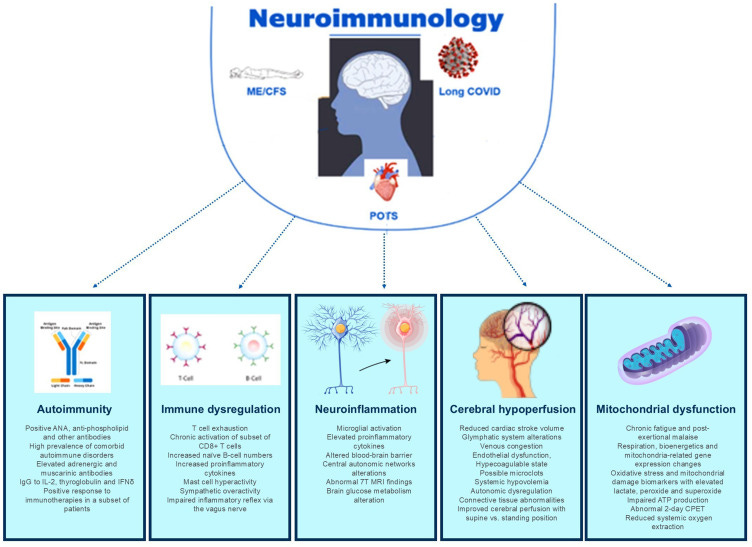
The autoimmune evidence is particularly well developed for PoTS. Multiple studies have identified antibodies targeting the autonomic nervous system, including adrenergic receptor antibodies, muscarinic receptor antibodies and angiotensin II type 1 receptor antibodies. As we decoded previously in The Antibodies That May Be Driving Your Symptoms, these are not passive bystanders. They are functionally active antibodies that interfere directly with the receptors controlling heart rate, blood pressure and vascular tone. Many of these same antibodies have now been found in patients with ME/CFS and long COVID, which the authors identify as a potential unifying mechanism across all three conditions. The G-protein coupled receptor antibodies in particular appear in the literature on all three, suggesting that the receptors mediating autonomic nervous system function are a shared target of immune dysregulation.
Neuroinflammation adds another layer. Using specialised PET scanning with a ligand targeting activated microglia, researchers have found evidence of microglial activation in long COVID patients, concentrated specifically in the ventral striatal and dorsal putamen regions. Advanced 7 Tesla MRI has identified structural abnormalities at the dorsolateral medulla in long COVID, a region that serves as a control centre for heart rate, blood pressure, respiration and digestive function. The authors propose this as a possible central nervous system localisation for both PoTS and long COVID, with implications for ME/CFS that have not yet been fully investigated.
Cerebral hypoperfusion rounds out the picture. Reduced blood flow to the brain and brainstem has emerged as a major mechanism across all three conditions, with several hypotheses proposed for why it occurs, including endothelial dysfunction, hypercoagulability, microclot formation and glymphatic system abnormalities. The relationship between hypoperfusion and neuroinflammation appears to be bidirectional, with each worsening the other in a cycle that research has only recently begun to map.
What reclassification would actually change
The case for reclassification is not purely academic. The authors are explicit that including these conditions within neuroimmunology would change clinical care pathways, educational curricula and diagnostic standards in ways that would have direct consequences for patients.
Currently, diagnosing PoTS requires a ten-minute stand test rather than the seated blood pressure check that most clinicians perform. Identifying the autoimmune subtype requires a serum panel testing for autonomic receptor antibodies. Detecting neuroinflammation requires specialised PET imaging. Assessing cerebral perfusion requires transcranial Doppler or advanced neuroimaging. None of these are routine. None are likely to become routine without specialist infrastructure and a field of medicine that considers these conditions its domain. Neuroimmunology already has that infrastructure for comparable conditions. The argument is that it should extend it here.
The authors are also clear about therapeutic implications. If PoTS, ME/CFS and long COVID are genuinely neuroimmune disorders, then immunomodulating therapies represent a rational and largely unexplored treatment frontier. Neurologists and neuroimmunologists are already trained in deploying such therapies for conditions like multiple sclerosis. Expanding the field’s scope would bring those tools and that expertise to bear on a patient population that currently has very limited treatment options.
The limitation the paper itself acknowledges
This is a narrative review, not a clinical trial. The mechanisms described are established to varying degrees: some are well replicated across multiple independent research groups, others remain proposed or emerging. The paper does not establish causation or provide treatment protocols. What it does is build a coherent mechanistic case for reclassification and make explicit the consequences of failing to act on the evidence that already exists.
The take home message
Researchers from Stanford, UC San Diego and the University at Buffalo have reviewed the mechanistic evidence across PoTS, ME/CFS and long COVID and concluded that all three conditions share the same pathophysiologic territory as established neuroimmune disorders. The same autoantibodies targeting autonomic receptors appear across all three. The same patterns of neuroinflammation, cerebral hypoperfusion and immune dysregulation recur throughout the literature. The biology connecting these conditions to the immune system and the nervous system is no longer emerging. It is documented.
The argument for reclassification is not semantic. It determines which specialists are trained to treat these patients, which diagnostic tools become standard of care and which therapeutic options get investigated. Multiple sclerosis was once called hysterical paralysis. The conditions are not mysterious. They are being measured with the wrong tools, by the wrong specialists, within the wrong framework. That is what this paper is asking the field to change. Whether it will is a different question…
Reference
Blitshteyn S, Doherty TA, Steinman L. Postural Orthostatic Tachycardia Syndrome, Myalgic Encephalomyelitis/Chronic Fatigue Syndrome and Long COVID as Neuroimmune Disorders. ImmunoTargets and Therapy. 2026;15:581262. doi: 10.2147/ITT.S581262
The views and opinions expressed in Dysautonomia Decoded are my own and do not represent those of my employer or any affiliated organisation.
I’m an AuDHD neurologist with almost all the above and more. My answer title is YES YES YES. Please check out my free educational podcast CLINICAL MISFITS, available wherever you get your podcasts
Yes 🙌