


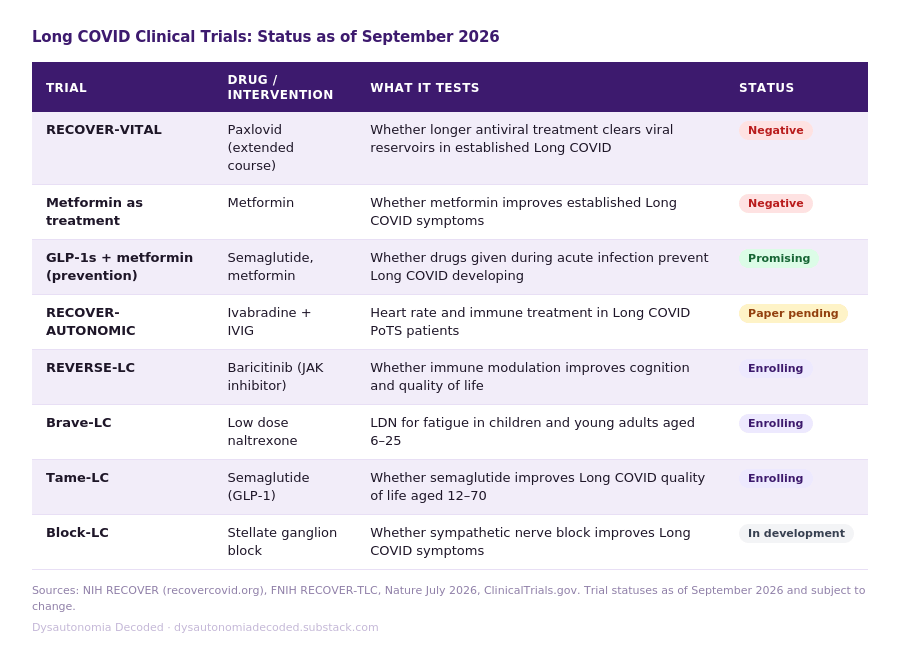
Today is day one in the new clinical trial series. To begin, let’s decode where the Long COVID clinical trial landscape actually stands in 2026. For years the field has been building toward results. Those results are now arriving, some of them are not what patients or researchers hoped for, some of them are genuinely promising, and together they are beginning to tell a coherent story about what Long COVID is and what it is not.
The treatments that have not worked
Two major hypotheses have now been formally tested and found wanting in properly designed randomised controlled trials. It is worth being clear about what that means and does not mean before discussing the findings.
A negative trial result tells you that a specific treatment did not produce significant improvement on specific outcomes in a specific patient population at a specific timepoint. It does not tell you that the underlying hypothesis was completely wrong, that the treatment could not work in a different subgroup, or that the biological mechanism it targeted is irrelevant. Negative results are not failures of science. They are information.
Extended Paxlovid
The RECOVER-VITAL trial tested the hypothesis that viral persistence drives Long COVID. If residual SARS-CoV-2 remaining in body tissues after apparent recovery is maintaining ongoing symptoms, then a longer course of an effective antiviral should clear that reservoir and improve outcomes.
The trial tested 15-day and 25-day courses of nirmatrelvir-ritonavir (Paxlovid) against the standard 5-day control course in established Long COVID patients. Results were posted in late March 2026 and were unambiguous: neither extended course produced significant improvement in post-exertional malaise, cognitive dysfunction, or orthostatic intolerance compared with the control arm.
This is an important finding. The Zuo et al. Lancet 2024 study we decoded previously found viral RNA in tissues up to four months after mild infection, with a 5.17-fold increased risk of Long COVID in those with persistent viral RNA. That finding motivated the RECOVER-VITAL hypothesis. The negative trial result does not overturn the viral persistence evidence. What it suggests is that currently available antivirals are not sufficient to clear established viral reservoirs in a way that meaningfully improves clinical outcomes, at least in the established Long COVID population tested. Whether earlier antiviral treatment, different antivirals, or antivirals combined with immune modulation might produce different results remains an open question.
Metformin as a treatment
Metformin was tested as a treatment for established Long COVID on the basis of its anti-inflammatory, antiviral, and mitochondrial effects. The result: it did not work as a treatment once Long COVID has set in.
This is a different finding to the prevention data discussed below, which is worth keeping separate in your mind. The same drug can have very different effects depending on when in the disease course it is given. Metformin given during acute infection may prevent Long COVID from developing. Metformin given to people who already have established Long COVID does not appear to improve outcomes. The biology of prevention is different from the biology of treatment.
The treatments showing promise
GLP-1 receptor agonists and metformin for prevention
A Nature news piece published in July 2026 summarised evidence from two 2026 trials suggesting that semaglutide and metformin, when given during the acute COVID-19 infection rather than after Long COVID has developed, significantly reduce the risk of Long COVID developing at all.
The distinction is crucial. These are prevention trials, not treatment trials. They do not help people who already have Long COVID. They suggest that intervening during the window of acute infection, before the biological processes that drive Long COVID become established, may be a tractable strategy. Given that GLP-1 agonists have anti-inflammatory and neuroprotective properties and that metformin has antiviral effects, the biological rationale is coherent. Independent replication is needed before these findings change clinical practice, but they represent the most promising preventive signal in the Long COVID field to date.
RECOVER-AUTONOMIC
This trial tested two treatments specifically in Long COVID patients with PoTS: ivabradine (a heart rate-lowering drug) and Gamunex-C (intravenous immunoglobulin, targeting autoimmune mechanisms). Results were presented at the American College of Cardiology Annual Conference in March 2026. The full paper is pending publication, which means a complete analysis is not yet available. What has been shared publicly is that ivabradine reduced heart rate in Long COVID PoTS patients, consistent with its known mechanism. Whether it improved symptoms meaningfully is one of the details that will become clear when the full paper publishes.
RECOVER-TLC: the most active trial programme currently running
The RECOVER-TLC programme is the most comprehensive active Long COVID treatment trial effort in the world, funded by the NIH and running across multiple US sites. As of mid-2026 it is recruiting and testing several interventions simultaneously: baricitinib, a JAK inhibitor used in rheumatoid arthritis that targets immune dysregulation; low dose naltrexone, which we have decoded in detail in a previous piece; semaglutide; and stellate ganglion block, a nerve block procedure targeting the sympathetic nervous system.
The simultaneous testing of multiple mechanistically distinct interventions reflects an important scientific maturity in how Long COVID is now being approached. Rather than betting on a single hypothesis, RECOVER-TLC is testing immune, autonomic, metabolic, and neurological targets in parallel. Results from these arms will arrive over the next one to two years.
What the overall picture tells us
Two findings from the negative trials deserve to be held together. Extended antivirals did not work in established Long COVID. Metformin did not work as a treatment in established Long COVID. Both of these are interventions that would work through mechanisms relevant early in the disease process: clearing viral reservoirs, preventing cellular metabolic damage, dampening the initial inflammatory cascade. Their failure in established Long COVID is consistent with a picture in which, once the condition is established, something has shifted in the biology that makes early-stage interventions insufficient.
What that shift is remains the central unanswered question. Autoimmune processes that have become self-sustaining. Mitochondrial damage that has become structural. Neuroinflammation that has become chronic. Endothelial dysfunction that has become a self-perpetuating loop. Probably some combination of these in different patients. The RECOVER-TLC trials are testing interventions that target these established-disease mechanisms rather than the early-disease mechanisms that Paxlovid and metformin targeted. Their results will be much more informative about whether established Long COVID is treatable.
No drug is yet approved for Long COVID. The average Long COVID patient still has no evidence-based treatment pathway. These trials represent the most serious scientific effort yet to change that.
The views and opinions expressed in Dysautonomia Decoded are my own and do not represent those of my employer or any affiliated organisation.
References
RECOVER COVID Initiative. RECOVER-VITAL trial results. March 2026. https://recovercovid.org
RECOVER COVID Initiative. RECOVER-AUTONOMIC trial results presented at ACC 2026. https://recovercovid.org
RECOVER COVID Initiative. RECOVER-TLC update July 2026. https://recovercovid.org/news/recover-tlc-july-2026
Nature. Can long COVID be prevented? Two drugs finally show promise. July 2026. https://doi.org/10.1038/d41586-026-02341-7
Zuo W, He D, Liang C, et al. The persistence of SARS-CoV-2 in tissues and its association with long COVID symptoms. Lancet Infectious Diseases. 2024;24(8):845–855. https://doi.org/10.1016/S1473-3099(24)00171-3
"Negative results are not failures of science. They are information." — I love that. And I'm glad to see stellate ganglion block in a randomised arm; it's an anesthesia procedure that's been offered for this outside of trials for a while now, so a real answer would be worth a lot. Do you know when that arm reports??