

Today let’s decode something that comes up constantly in the PoTS and EDS community but has received relatively little accessible science writing. The overlap between dysautonomia, hypermobility and neurodivergent conditions including ADHD and autism. If you have PoTS or EDS and are also neurodivergent, or if you have noticed that a striking number of people in chronic illness communities are, you are not imagining a pattern. The research documents it and the biological mechanisms connecting these conditions are becoming increasingly clear.
How common is the overlap?
The numbers are striking enough that they warrant stating clearly before explaining why.
A 2016 nationwide population-based cohort study from Sweden, examining 10,000 individuals with EDS or hypermobility syndrome, found that people with EDS were 7.4 times more likely to have an autism spectrum disorder diagnosis compared to matched controls. They were 5.6 times more likely to have ADHD.
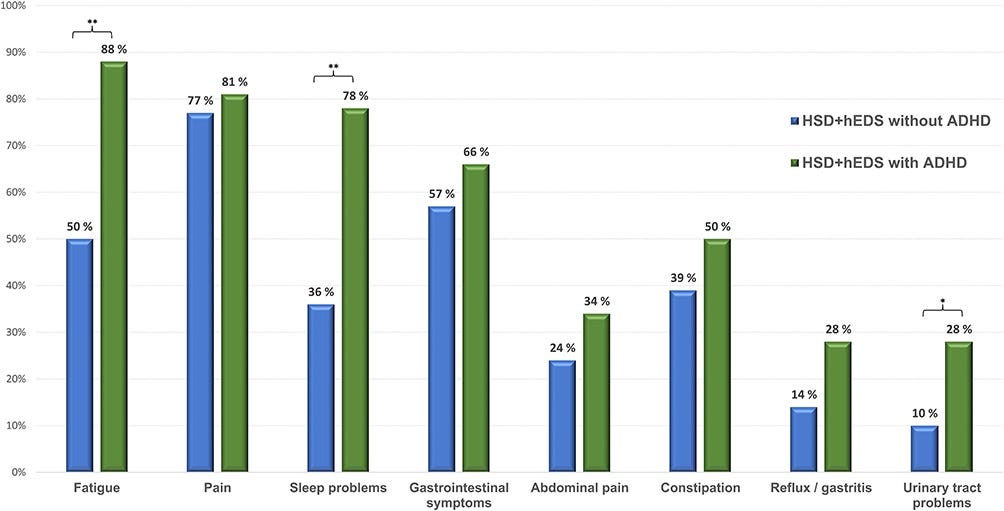
A 2022 study published in Frontiers in Psychiatry by Dr Jessica Eccles and colleagues at Brighton and Sussex Medical School examined 109 adults with confirmed neurodevelopmental diagnoses, autism, ADHD, or Tourette syndrome, alongside a comparison group. Approximately half of the neurodivergent adults had generalised joint hypermobility. Critically, those with both hypermobility and a neurodevelopmental condition showed significantly higher rates of dysautonomia and chronic pain than those with either condition alone. The paper’s title makes the relationship explicit: Joint Hypermobility Links Neurodivergence to Dysautonomia and Pain.
A 2021 retrospective study specifically in children with hypermobility spectrum disorders or hypermobile EDS found that 37.4% had ADHD and 25.3% had autism spectrum disorder. These are not small percentages in a condition that affects connective tissue throughout the body.
The hEDS GWAS preprint we decoded last week, the first genome-wide association study of hypermobile EDS, found significant genetic correlations between hEDS and autism spectrum disorder at the level of 3D genomic architecture. The shared biology is not just clinical observation. It is detectable at the genetic level.
Why does this overlap exist?
Several mechanisms have been proposed and the evidence for each is at different stages of development. None of these is mutually exclusive and the most likely explanation is that multiple mechanisms operate simultaneously in different individuals.
Connective tissue as a shared vulnerability
Connective tissue is not just in joints. It is in the brain, surrounding nerves, lining blood vessels, supporting virtually every structure in the body. Collagen, the main structural protein in connective tissue, is present in the extracellular matrix of the brain and plays a role in neural connectivity, synaptic function and the structural integrity of the blood-brain barrier.
If connective tissue is subtly different in hEDS and hypermobility spectrum disorders, the consequences are not confined to flexible joints and fragile skin. They extend to the nervous system. Altered collagen composition in the brain’s extracellular matrix could plausibly influence neural development, synaptic organisation and neurotransmitter signalling in ways that contribute to neurodivergent presentations. This is a mechanistic hypothesis rather than an established causal pathway, but it is biologically coherent and consistent with the genetic overlap identified in the EDS GWAS.
Interoception: the body’s internal sense
Interoception is the brain’s ability to sense and interpret signals from inside the body: heart rate, hunger, pain, temperature, bladder fullness, the feeling of breathing. It is a critical but underappreciated sensory system that bridges the physical and the experiential.
Both autistic people and people with PoTS and dysautonomia show altered interoceptive processing. In autism, interoceptive differences are well documented, affecting how physical sensations are detected, interpreted and responded to. In dysautonomia, the autonomic nervous system’s signalling to the brain about internal body state is by definition dysregulated. The insula, the primary interoceptive cortex, is implicated in both conditions.
Dr Eccles’s research specifically highlights interoception as a potential mechanistic link between hypermobility, dysautonomia, pain and neurodivergence. When the body sends atypical signals about its internal state, the brain learns to interpret the world differently. This may contribute both to neurodivergent sensory experiences and to the amplified symptom burden seen when hypermobility, dysautonomia and neurodivergence co-occur.
The autonomic nervous system in ADHD and autism
Autonomic dysregulation is increasingly recognised as a feature of both ADHD and autism, not just of PoTS. A 2023 systematic review in Cognitive Neuropsychiatry found consistent evidence of autonomic nervous system dysregulation in adult ADHD, including altered heart rate variability and sympathovagal imbalance. Multiple studies document reduced heart rate variability in autistic individuals compared to neurotypical controls, a finding consistent with reduced parasympathetic tone.
This means that when ADHD or autism co-occurs with PoTS, two conditions involving autonomic dysregulation are present simultaneously. The autonomic challenges are not simply additive. They interact and the clinical presentation is more complex than either condition alone would predict.
Around 70% of people with hEDS report PoTS. Dysautonomia is well documented in autistic adults too. When both are present, exercise tolerance, sensory needs and pacing requirements become considerably more involved than either condition on its own would suggest, with practical consequences for management that most clinical pathways are not designed to address.
Mast cells as a potential bridge
MCAS sits at an interesting intersection in this picture. Mast cells are found in high concentrations in the brain, gut and connective tissue. Their activation releases histamine and other mediators that influence both the autonomic nervous system and neurological function. MCAS is already documented at elevated rates in PoTS and EDS patients. Emerging evidence suggests mast cell involvement may also be relevant in a subset of autistic people, potentially contributing to sensory hypersensitivity, gastrointestinal symptoms and autonomic features.
This is an area where the research is genuinely early and the claims made in patient communities sometimes run ahead of the evidence. What can be said confidently is that the mast cell-autonomic nervous system-connective tissue axis is biologically plausible as a bridge between these conditions and that properly powered studies examining mast cell function across neurodivergent and dysautonomia populations have not yet been conducted.
What this means in practice
The clinical implications of this overlap are underappreciated. A neurodivergent person with dysautonomia may present atypically, may struggle to describe their symptoms in the way clinical settings expect and may have a higher threshold for seeking care despite significant symptom burden. The interaction between sensory processing differences and autonomic symptoms can make symptoms harder to separate and characterise.
If you have PoTS or EDS and are also neurodivergent, or suspect you might be, the co-occurrence is well documented and biologically coherent. It is not a coincidence, not a misdiagnosis and not the result of health anxiety or symptom amplification. It reflects shared biological vulnerabilities that research is increasingly mapping, from the genetics of connective tissue to the interoceptive brain.
For clinicians: the presence of one of these conditions should lower the threshold for considering others. A patient presenting with hypermobility and autonomic symptoms deserves screening for ADHD and autism. A neurodivergent patient presenting with fatigue, dizziness on standing, or exercise intolerance deserves an active stand test.
The limitations worth naming
Much of the research in this area comes from relatively small studies, single-centre cohorts and clinical populations that may not represent the full range of people with these conditions. The mechanistic hypotheses, particularly around interoception and mast cells, are better supported in some conditions than others and require larger, properly controlled studies. Causality has not been established in most of these relationships: we know the conditions co-occur more than expected, but the direction of effect and the precise mechanisms remain under investigation.
The views and opinions expressed in Dysautonomia Decoded are my own and do not represent those of my employer or any affiliated organisation.
References
Csecs JLL, Iodice V, Rae CL, et al. Joint hypermobility links neurodivergence to dysautonomia and pain. Frontiers in Psychiatry. 2022;12:786916. https://doi.org/10.3389/fpsyt.2021.786916
Cederlöf M, Larsson H, Lichtenstein P, et al. Nationwide population-based cohort study of psychiatric disorders in individuals with Ehlers-Danlos syndrome or hypermobility syndrome and their siblings. BMC Psychiatry. 2016;16:207. https://doi.org/10.1186/s12888-016-0922-6
Kindgren E, Quiñones Perez A, Knez R. Prevalence of ADHD and autism spectrum disorder in children with hypermobility spectrum disorders or hypermobile Ehlers-Danlos syndrome. Neuropsychiatric Disease and Treatment. 2021;17:379–388. https://doi.org/10.2147/NDT.S290494
Geiss L, Stemmler M, Beck B, et al. Dysregulation of the autonomic nervous system in adult attention deficit hyperactivity disorder: a systematic review. Cognitive Neuropsychiatry. 2023;28(4):285–306. https://doi.org/10.1080/13546805.2023.2255336
Petrucci-Nelson T, et al. Complex genetics and regulatory drivers of hypermobile Ehlers-Danlos syndrome. medRxiv preprint. 2025. https://doi.org/10.1101/2025.09.19.25336146
Eccles JA. Bendy bodies, ADHD brains: connecting the dots. ADDitude Magazine. 2025.
Is there any research on how dyslexia, afantasia, and neurodivergence around learning styles and imagery play into theses patterns? Any treatments that appear more effective for each cohort? Any research on if these same groups are more likely to have long covid, allergies, asthma, fibromyalgia, etc? And, any ideas on how to help children or those at higher risk for developing these sorts of challenges?