

What If Your Immune System Is Causing Your PoTS?
A decade of research suggests autoantibodies may be attacking the receptors that control your heart rate and blood vessels. Here is what we know and what we don't.

Today let’s decode one of the most significant and least discussed questions in PoTS research. What if the condition isn’t primarily a cardiovascular problem, or a nervous system problem, or a volume problem, but an immune system problem? What if the body is, in some patients, quite literally attacking itself in a way that disrupts autonomic function?
This is not a fringe hypothesis. It has been building in the peer reviewed literature for over a decade, it has been accelerated significantly by Long COVID research, and it has real implications for how PoTS is diagnosed and treated. Yet most patients have never had it mentioned in a consultation.
The immune system and the autonomic nervous system are not separate
To understand the autoimmune hypothesis in PoTS, it helps to understand what autoantibodies actually are. In a healthy immune response, antibodies are produced to identify and neutralise foreign threats, viruses, bacteria, that kind of thing. Autoantibodies are antibodies that misfire and target the body’s own tissues instead. This is the mechanism behind conditions like rheumatoid arthritis, lupus, and Hashimoto’s thyroiditis.
The specific targets in PoTS appear to be receptors on the surface of heart cells and blood vessel cells, particularly adrenergic receptors, which respond to adrenaline and noradrenaline, and muscarinic receptors, which respond to the parasympathetic nervous system. These receptors are central to how heart rate and blood pressure are regulated. If autoantibodies are interfering with their function, the downstream effects would look exactly like PoTS.
How the evidence developed
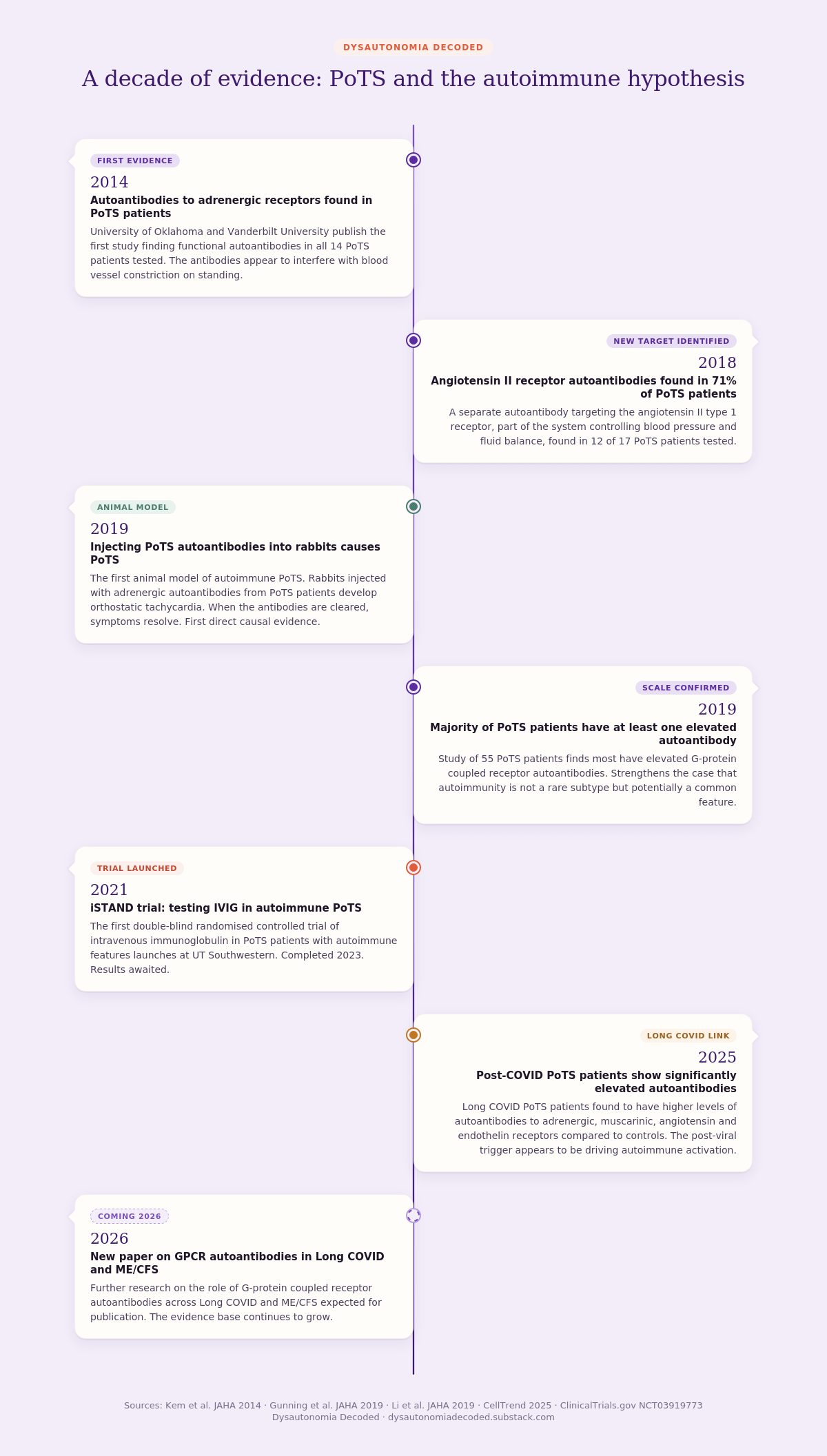
The story starts in 2014, when researchers at the University of Oklahoma and Vanderbilt University published the first study finding functional autoantibodies to adrenergic receptors in PoTS patients. In all 14 patients studied, the serum showed abnormal arteriolar contractile activity that was suppressed when adrenergic receptors were blocked, suggesting the autoantibodies were functionally active, not just present.
This was followed in 2019 by a larger study of 55 PoTS patients finding that the majority had at least one elevated G-protein coupled adrenergic receptor autoantibody. The same group identified autoantibodies to angiotensin II type 1 receptors, part of the hormone system that controls blood pressure and fluid balance, in 12 of 17 PoTS patients tested. The picture was becoming more complex and more compelling simultaneously.
A 2019 animal model study then showed that injecting adrenergic autoantibodies from PoTS patients into rabbits produced a PoTS-like syndrome in the animals, including exaggerated orthostatic tachycardia and adrenergic receptor dysfunction. Crucially, when the autoantibodies were cleared using decoy peptide inhibitors, the symptoms resolved. This was the first direct evidence in a living organism that these antibodies could cause the condition, not just correlate with it.
What Long COVID added to the picture
The explosion of post-viral PoTS following COVID-19 infection gave the autoimmune hypothesis a significant boost. A 2025 study from CellTrend, a laboratory specialising in GPCR autoantibody testing, found that PoTS patients with post-COVID syndrome had significantly higher levels of autoantibodies to adrenergic alpha1, adrenergic beta2, muscarinic M4, angiotensin II and endothelin receptors compared to healthy controls. A further paper on the same topic is expected imminently in 2026.
This makes biological sense. COVID-19 is known to trigger autoimmune responses. Molecular mimicry, where the virus shares structural similarities with human proteins and the immune response to the virus ends up targeting those proteins, is one proposed mechanism. Bystander activation, where widespread immune activation during infection causes previously tolerant immune cells to become reactive to self-antigens, is another. The fact that PoTS so frequently follows viral illness, and that SARS viruses have been linked to dysautonomia since 2002, fits neatly into this framework.
Why aren’t we testing for these antibodies
This is the maddening part. The research is consistent enough to take seriously, yet testing for these autoantibodies is not available as a standard clinical tool. The assays used in research settings are not yet validated for routine diagnostic use, the panels are not standardised across laboratories, and the clinical utility remains formally unproven in larger cohorts.
There are also genuine scientific caveats. Not every study has found the same antibodies in the same proportions, and some studies using different detection methods have found no significant difference in autoantibody levels between PoTS patients and healthy controls. Whether these antibodies are causative or simply present is still being debated. And even among patients who do have elevated autoantibodies, it is not yet clear which ones are clinically meaningful versus incidental.
A double-blind randomised controlled trial, the iSTAND study at UT Southwestern, specifically tested intravenous immunoglobulin, a treatment that modulates the immune system, in PoTS patients with autoimmune features. The trial completed in 2023 and results are anticipated to inform whether treating the immune component actually improves outcomes.
What this means for patients right now
If the autoimmune hypothesis is correct for even a subset of PoTS patients, the implications are significant. It would mean that some patients need immunotherapy rather than, or alongside, the volume loading and heart rate management that currently dominates treatment. It would mean that a blood test could one day replace or complement the tilt table test for diagnosis. And it would mean that the post-viral trigger so many patients report is not incidental history but a key piece of mechanistic information.
For now, there is no validated blood test available and no approved immunotherapy for PoTS. But the trajectory of the research is clear. The immune system is increasingly central to how PoTS is understood, and the treatment implications of that, if confirmed in larger trials, could be transformative.
You are not imagining the connection between your viral illness and your diagnosis. The science is catching up.
References
Gunning WT, Karabin BL, Grubb BP. Postural orthostatic tachycardia syndrome is associated with elevated G-protein coupled receptor autoantibodies. Journal of the American Heart Association. 2019;8(18):e013602. https://doi.org/10.1161/JAHA.119.013602
Li H, et al. Adrenergic autoantibody-induced postural tachycardia syndrome in rabbits. Journal of the American Heart Association. 2019;8(18):e013006. https://doi.org/10.1161/JAHA.119.013006
Fedorowski A, et al. Antiadrenergic autoimmunity in postural tachycardia syndrome. EP Europace. 2017;19(7):1211-1219. https://doi.org/10.1093/europace/euw154
Kem DC, et al. Autoimmune basis for postural tachycardia syndrome. Journal of the American Heart Association. 2014;3(1):e000755. https://doi.org/10.1161/JAHA.113.000755
CellTrend. New study about functional autoantibodies in post-acute sequela of COVID-19. 2023. https://www.celltrend.de/en/new-study-about-functional-autoantibodies-in-post-acute-sequela-of-covid-19-published/
iSTAND Trial. IVIG treatment study for POTS subjects. ClinicalTrials.gov NCT03919773. https://clinicaltrials.gov/study/NCT03919773
Very interesting! It has been more manageable since I started meds for my autoimmune condition.
Thanks for all you do. Your work is the most relevant of any source for me right now. This particular piece reinforces my continuing both LDN (1.5 mg) and Sirolimus (2 mg/week) in low doses even though I don't see any specific results.